
What Crown Transplant Results Can You Expect?
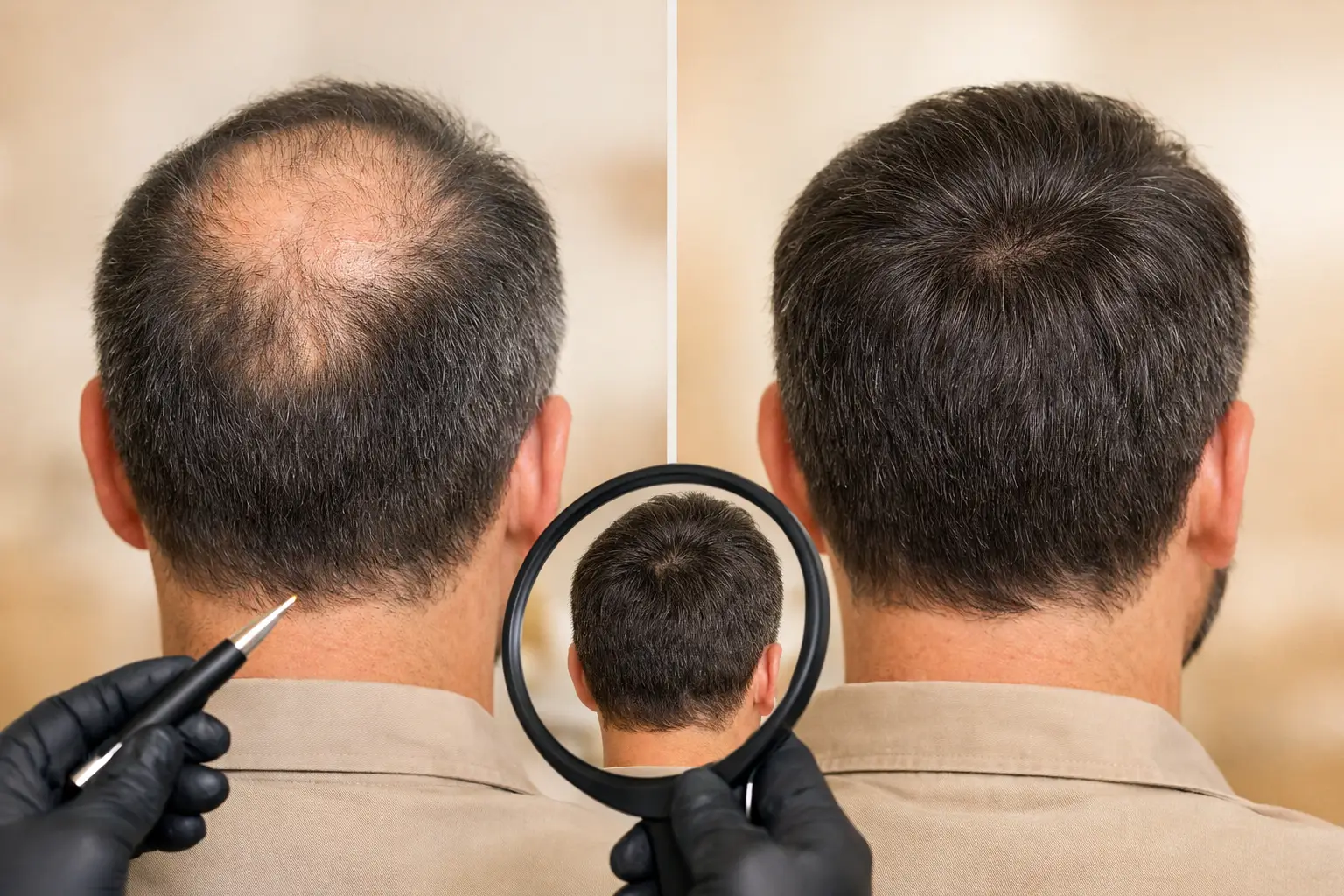
A thinning crown can be frustrating because it is often harder to see yourself, yet very visible in photos, overhead lighting and mirrors. Crown transplant results can be highly natural-looking, but this area demands careful planning, realistic expectations and patience while the transplanted hair establishes itself.
The crown, also called the vertex, is not simply a flat patch of scalp that needs filling. Hair grows in a circular pattern around a natural whorl, and density has to blend into the surrounding hair from every angle. A well-planned transplant can improve coverage and confidence, but the final outcome depends on factors such as the extent of hair loss, donor hair availability, hair characteristics and whether future loss is likely.
Why the crown needs a different approach
The crown commonly appears less dense than other areas even when a reasonable number of hairs are present. This is partly because the hair whorl separates strands in different directions, allowing more scalp to show through. Fine or straight hair, strong contrast between hair and scalp colour, and bright overhead light can make the effect more noticeable.
A hair transplant in this area needs to follow your individual growth pattern. Medical professionals place grafts at carefully chosen angles and directions so new hair supports the existing swirl rather than sitting against it. If the direction is wrong, even healthy growth may look unnatural or fail to create the coverage you expected.
The crown can also require a significant number of grafts because it covers a broad surface area. For someone with progressive pattern hair loss, a dense crown transplant alone may not be the best use of a limited donor supply. The frontal hairline and mid-scalp often frame the face more visibly, so treatment planning may involve prioritising areas according to your current hair loss and long-term goals.
Crown transplant results: the realistic timeline
Hair restoration is a gradual process. A transplant moves follicles from a donor area, usually at the back or sides of the scalp, into thinning areas. Those follicles need time to settle, cycle and produce new visible hair.
In the first one to two weeks, small scabs and redness are common as the recipient area heals. Your treating team will provide instructions on washing, exercise, sun exposure and how to avoid disturbing the grafts. Following this aftercare closely supports healing and protects the newly placed follicles.
Between roughly two and eight weeks after the procedure, many transplanted hairs shed. This can feel concerning, especially when you have invested emotionally in treatment, but it is a common part of the growth cycle. The follicle remains beneath the skin and begins producing new hair later.
Early new growth may become visible from around three to four months. At this stage, it can look fine, uneven or softer than expected. This does not represent the finished result. More noticeable coverage commonly develops between six and nine months, while crown transplant results often continue to mature for 12 months or longer. The crown may be slower to show visual change than the hairline because its wider surface area needs more growth before it appears substantially fuller.
What affects how full the crown can look?
No two transplants produce identical density. A consultation should assess the quality of the donor area as well as the recipient area, rather than treating graft numbers as a promise of a particular result.
Hair calibre makes a meaningful difference. Coarser hair can provide more visual coverage per graft than very fine hair. Naturally wavy or curly hair may also create a fuller appearance because it sits away from the scalp. Colour contrast matters too. Dark hair against a light scalp can make thinning more apparent, whereas similar hair and scalp tones can create the impression of greater density.
The size of the thinning area is equally relevant. A small crown spot with stable surrounding hair may respond very differently from advanced loss extending through the mid-scalp. Existing native hair can enhance the visual effect of transplanted follicles, but if that hair continues to thin, the crown may look less full over time without a plan to manage ongoing hair loss.
Your age, family pattern of loss and the stability of your hair loss will also be considered. A medical professional may recommend delaying surgery, combining it with non-surgical treatment, or taking a staged approach where this is clinically appropriate. These decisions are about preserving donor hair and pursuing an outcome that still makes sense in future years.
Density versus natural coverage
Many people ask whether a crown transplant will restore the density they had as a teenager. In some cases, that is not realistic or advisable. The donor area has a finite supply of follicles, and transplanting too aggressively can affect both the donor area and the ability to address future thinning.
The aim is usually natural coverage that reduces scalp visibility and works with your existing hair. This can look very effective in daily life, particularly once hair has been styled and has reached mature thickness. It may not look equally dense under every condition, such as wet hair, direct downlights or an extremely close inspection. A trustworthy consultation should discuss this openly rather than presenting edited images as a guaranteed outcome.
Some people require a second procedure later, particularly where hair loss progresses or the crown area was extensive from the outset. This is not automatically a sign that the first procedure failed. It can be part of a long-term plan for a condition that may continue to develop.
Procedure choice and professional planning
Follicular unit extraction, often called FUE, is a commonly used approach in which individual follicular units are removed from the donor area and implanted into the recipient area. The right technique and graft plan should be based on your scalp, donor density, hair characteristics and treatment priorities.
Careful assessment matters more than a one-size-fits-all graft package. Your clinician should examine the donor area, map the crown pattern, discuss your medical history and explain what level of coverage is achievable. They should also make clear who will carry out each clinical part of the procedure and what aftercare is available.
At Luxe Medical Procedures, hair restoration is approached as a clinically delivered medical procedure, with planning centred on suitability, safety and achievable outcomes. For patients in Newcastle, Brisbane or Perth, an in-person consultation can help clarify whether crown transplantation, PRP treatment or another approach best fits their concerns.
Supporting existing hair after a transplant
A transplant redistributes healthy follicles. It does not stop pattern hair loss in non-transplanted hair. If there is active thinning around the crown, medical advice about ongoing management can be valuable.
Depending on your circumstances, this may include clinically appropriate hair-loss medication or PRP treatments. PRP uses a concentrated component of your own blood and may be considered as a supportive treatment for thinning hair. It is not a substitute for sufficient grafts in a significantly bare crown, and outcomes vary, but it may form part of a broader plan for suitable patients.
Good general scalp care, realistic styling choices and attendance at follow-up appointments also matter. Avoid judging your outcome week by week. Taking consistent photos in the same lighting every few months gives a far more useful picture of genuine change.
Questions worth asking before treatment
Before committing to a crown transplant, ask how many grafts are being proposed and why, how your natural crown direction will be recreated, and whether your donor area can support the plan. Ask what result is realistic at 6, 12 and 18 months, whether ongoing hair loss could affect the appearance, and who will provide your clinical care.
It is also sensible to ask about the total cost, including any recommended follow-up treatment, rather than comparing procedures on a headline price alone. Affordable care should still involve proper medical assessment, clear aftercare and transparent expectations.
The most satisfying crown transplant results are rarely about chasing perfect density. They come from a careful plan that respects your available donor hair, follows your natural growth pattern and gives new growth the time it needs to do its work.