
DHI Versus FUT Transplant: Which Suits You?
A hair transplant consultation should not begin with a sales pitch for one technique. It should begin with your pattern of hair loss, the strength of your donor hair and what you want your hairline to look like years from now. When comparing a DHI versus FUT transplant, the real question is not which method is universally better. It is which approach supports a safe, natural-looking and realistic plan for you.
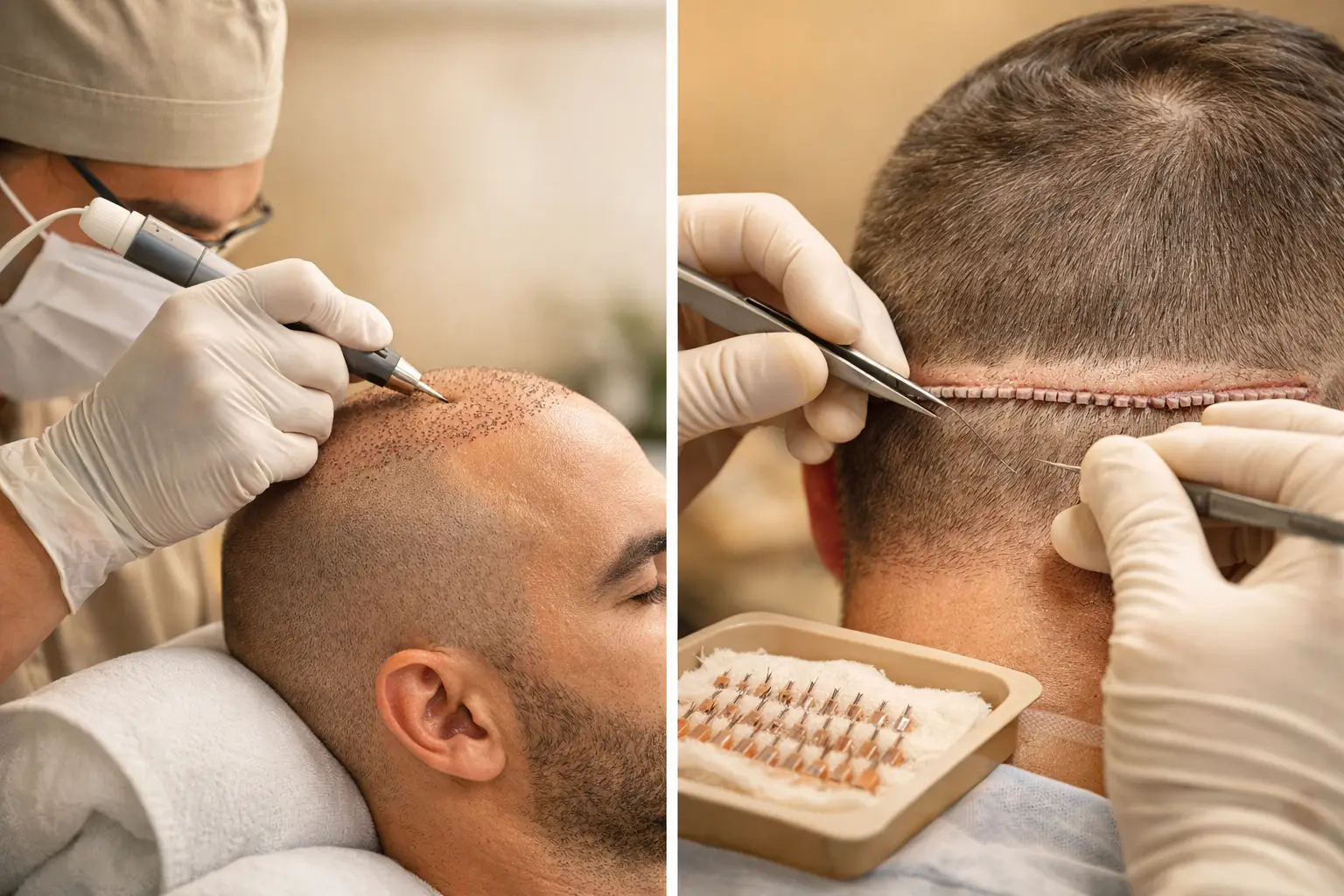
DHI and FUT are both established ways to move healthy hair follicles from a donor area, usually the back and sides of the scalp, to areas affected by thinning or hair loss. They differ mainly in how follicles are collected and implanted, which affects scarring, recovery, cost and suitability.
DHI versus FUT transplant: the key difference
DHI stands for Direct Hair Implantation. In practice, DHI commonly involves extracting individual follicular units from the donor area, then placing them into the recipient area using a specialised implanter device. The clinician loads each graft into the device and implants it at a planned angle, depth and direction.
FUT stands for Follicular Unit Transplantation. It is also known as the strip method. A narrow strip of scalp is removed from the donor area and carefully dissected under magnification into individual follicular unit grafts. These grafts are then placed into tiny recipient sites across the thinning area.
The fundamental distinction is donor harvesting. DHI generally uses individual extraction, while FUT removes a strip of donor tissue. DHI is sometimes presented as a completely separate transplant category, but the terminology can be confusing. The most meaningful clinical discussion is about how grafts are harvested, how they will be placed, and how your donor area will be managed over time.
Scarring and hairstyle considerations
Scarring is often the first practical concern for people choosing between DHI and FUT.
A DHI procedure using individual extraction leaves small, dot-like scars in the donor area. Once healed, these are often difficult to notice with a short-to-medium haircut, but they are still scars. If the hair is clipped extremely short, some people may see small lighter areas or changes in texture, particularly if a large number of grafts has been extracted.
FUT leaves a linear scar along the donor area where the strip is removed. With an experienced surgical approach and appropriate healing, the scar can usually be concealed by surrounding hair. However, FUT may be less suitable for someone who strongly prefers a very short or shaved hairstyle.
Neither method is scar-free. A reputable provider should be clear about that from the outset. Your skin type, scalp laxity, healing tendencies, hair characteristics and the number of grafts required all influence how noticeable scarring may be.
Graft numbers and donor hair preservation
For people with more advanced pattern hair loss, graft requirements can become substantial. FUT may be considered when a larger number of grafts is needed in one session because it can provide an efficient way to access donor follicles while preserving the appearance of the surrounding donor area.
DHI can also be suitable for significant restoration work, although large sessions may take longer and require careful planning. Individual extraction needs to be performed conservatively. Removing too many follicles too close together can reduce donor density and create a patchy or over-harvested appearance.
This is why donor management matters more than procedure labels. Your donor hair is a limited resource. A clinically responsible plan considers not only what can be achieved now, but also what may be needed if hair loss progresses in future.
A patient with early recession may need a conservative hairline design that leaves options available later. Someone with stable, established hair loss and strong donor density may be a candidate for broader coverage. The right answer depends on a medical assessment, not a standard package.
Hairline detail and placement precision
DHI is often associated with detailed work around the hairline, temples and crown because the implantation device can allow controlled graft placement. This can be useful where angle and direction are especially important for a natural result.
That said, natural-looking outcomes are not created by a device alone. The clinician's planning, artistic judgement and understanding of hair growth patterns are central to the result. A FUT procedure can also produce refined hairline work when grafts are prepared and placed carefully.
For either method, the quality of the hairline design matters. A hairline that sits too low or looks too dense for a person's age and likely future hair loss can become difficult to manage. A good plan should look appropriate now and remain believable over time.
Recovery after DHI and FUT
Both procedures involve a recovery period, although the experience differs.
After DHI, the donor area may feel tender and the recipient area can develop redness, swelling and small scabs. Most people can return to light, non-strenuous activities relatively quickly, but need to follow aftercare instructions carefully. This commonly includes avoiding strenuous exercise, direct sun exposure, swimming and anything that may rub or disturb the grafts during the early healing period.
Following FUT, the donor area may feel tighter or more uncomfortable because of the incision and sutures or staples, depending on the technique used. There may be restrictions around exercise and head movement while the incision heals. Follow-up is required to assess healing and remove sutures or staples where relevant.
With either approach, transplanted hairs commonly shed in the weeks after surgery. This can be expected and does not necessarily mean the grafts have failed. New growth typically begins gradually over subsequent months, and final maturation takes time. Hair restoration is not an overnight change, so realistic expectations are part of good clinical care.
Cost: why a like-for-like comparison matters
It is understandable to compare transplant prices, particularly when hair restoration can feel financially out of reach. However, a lower quote is not always a lower-cost procedure in the long term, and a higher quote does not automatically mean better care.
The total cost may reflect graft numbers, the complexity of hair loss, the technique used, medical professional involvement, clinical facilities, follow-up care and whether the plan includes a staged approach. DHI may cost more in some cases because individual implantation can be time-intensive. FUT may offer value when a larger graft count is required, but suitability should never be decided on price alone.
Ask what the quoted treatment includes and whether the graft estimate is based on your actual donor capacity. A clear consultation should explain the anticipated number of grafts, the technique proposed, possible limitations and the expected aftercare. Affordable treatment should still be clinically led and properly planned.
When DHI may be the better fit
DHI may be worth considering if you prefer to avoid a linear donor scar, usually wear your hair shorter, or need carefully targeted work in a smaller area such as a receding hairline. It may also suit people whose treatment plan calls for specific control over graft placement.
However, DHI is not automatically the best choice for every person with thinning hair. Someone needing extensive coverage may have different priorities, including efficient graft yield and long-term donor preservation.
When FUT may be the better fit
FUT may be appropriate for people who need a larger number of grafts, have good scalp laxity and usually keep enough hair length to conceal a linear scar. It can be a sensible option when the goal is to achieve meaningful coverage while avoiding widespread individual extraction from the donor area.
The trade-off is the linear scar and the recovery associated with the donor incision. For some patients, that is an acceptable compromise. For others, it is a deciding factor against the procedure.
Questions to take to your consultation
Before choosing a technique, ask how your hair loss pattern may progress, how many grafts your donor area can safely provide and why the recommended method suits your goals. It is also reasonable to ask who will carry out each stage of the procedure, what aftercare is included and what result is realistically achievable at your current stage of hair loss.
People with early thinning may also benefit from discussing non-surgical support, including clinically administered PRP treatments where appropriate. A transplant redistributes existing follicles. It does not stop ongoing loss in non-transplanted hair, so a broader hair-restoration plan can be valuable.
The best decision is one made with clear information, realistic expectations and medical guidance. Whether DHI or FUT is recommended, choose a procedure that respects your donor hair, supports your long-term appearance and is carried out with the professional care your treatment deserves.