
Does Donor Hair Grow Back After a Transplant?
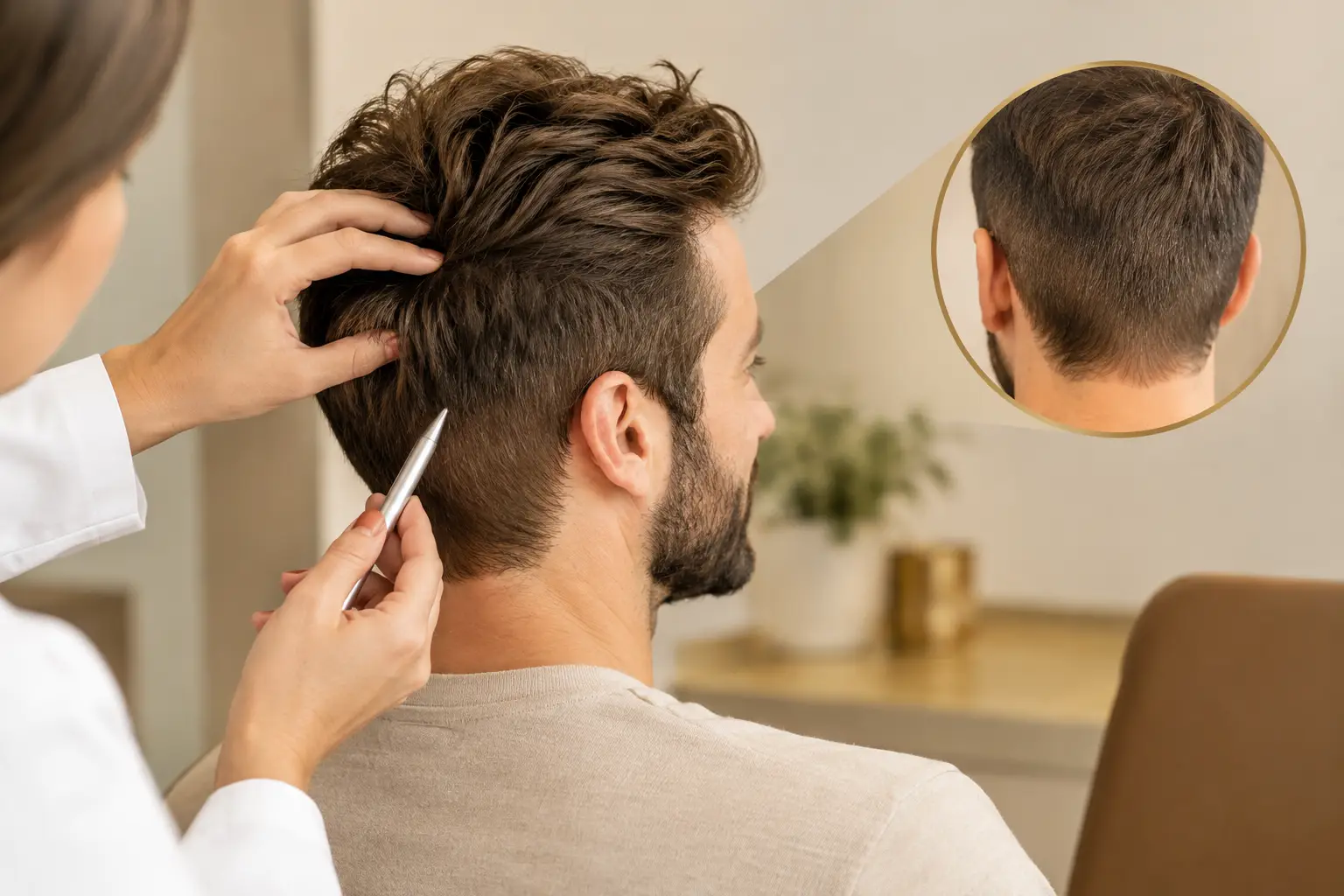
The question, does donor hair grow back, goes to the heart of whether a hair transplant feels like a sensible long-term option. The straightforward answer is that hairs removed from the donor area do not regrow from the exact follicles extracted. However, when a transplant is carefully planned and carried out by medical professionals, the donor area can heal well and continue to look naturally full.
That distinction matters. A hair transplant redistributes your own permanent hair rather than creating new hair. The aim is to improve thinning areas without leaving the back and sides of the scalp looking noticeably depleted.
Does donor hair grow back after FUE?
Follicular Unit Extraction, usually called FUE, involves removing individual follicular units from the donor area, commonly at the back and sides of the scalp. Each unit may contain one to several hairs. Once a follicle is extracted and transplanted, it grows in its new location after the normal recovery cycle. It does not produce a replacement hair in the donor site.
The small extraction sites do heal. In the days after treatment, you may see tiny scabs and short-term redness. These generally settle as the skin recovers. Because follicles are selected and removed across a broad area rather than from one concentrated patch, a well-designed FUE procedure can preserve an even-looking donor zone.
This is why the quality of planning matters as much as the technique itself. Taking too many grafts, extracting them too closely together, or operating outside the patient’s true safe donor area can leave visible thinning. A medically led assessment considers the density, texture, colour contrast and future stability of your hair before recommending a graft number.
Why the donor area can still look full
People sometimes assume every extracted hair will leave a visible gap. In reality, the donor area contains thousands of hairs, and a transplant uses only a carefully calculated portion of suitable follicles. Hair around the removed grafts continues to grow, helping to cover the healed extraction points.
The result depends on your starting donor density. Someone with thick, dark hair and good density may be able to donate more grafts than someone with naturally fine or sparse hair. Curly or wavy hair can also offer more visual coverage than straight hair. These are not quality judgements - they are practical factors that shape what can be achieved safely.
What about FUT donor hair removal?
Follicular Unit Transplantation, or FUT, removes a narrow strip of scalp from the donor area. The surrounding skin is then closed with sutures, and follicular units are prepared for transplantation. Hair removed within that strip does not grow back, because the follicles have been relocated.
Unlike FUE, FUT leaves a linear scar rather than many small extraction marks. With appropriate surgical technique and healing, the scar is often concealed by surrounding hair, particularly when it is worn at a moderate length. It may be more noticeable for people who prefer a very short haircut.
FUT can be suitable for some patients, particularly where a larger number of grafts is required and the scalp has good laxity. It is not automatically better or worse than FUE. The right approach depends on your donor supply, hair goals, hairstyle preferences, medical history and the likelihood of further hair loss.
Donor hair is a limited resource
The most useful way to think about donor hair is as a finite reserve. The follicles at the back and sides of the scalp are often more resistant to pattern hair loss, which is why they are used for transplantation. But they are still limited in number.
A responsible treatment plan should account for your future, not just your current hairline. If hair loss is still progressing, using too much donor hair early may reduce options later. This is especially relevant for younger adults and for anyone with a strong family history of extensive thinning.
At Luxe Medical Procedures, hair transplant recommendations are made with donor preservation and natural-looking coverage in mind. An affordable procedure should still be clinically appropriate, carefully designed and delivered with the long term considered.
Can the donor area look thinner after surgery?
It can, particularly if too many grafts are taken or if the person’s donor density was limited from the beginning. This is known as overharvesting. It can create a patchy or moth-eaten appearance, especially with a short haircut or under bright light.
Temporary shedding can also occur. Nearby hairs may enter a resting phase after the procedure, sometimes called shock loss. These hairs were not removed and will often grow back over the following months. This differs from extracted follicles, which have been permanently relocated.
Occasionally, pre-existing thinning in the donor area becomes more obvious after surgery. A detailed assessment can identify signs of unstable or diffuse hair loss and help avoid using hair that may not remain reliable over time.
What healing looks like in the donor area
Most people can expect the donor area to feel tender for a short period after a hair transplant. With FUE, small crusts usually form around the extraction points and come away during the advised washing routine. With FUT, there is an incision that needs specific aftercare and a period of protection while it heals.
Your treating team will give you clear instructions on washing, sleeping, exercise and sun exposure. Following them supports normal healing and reduces the chance of infection, unnecessary irritation or damage to the surrounding hair.
Healing timelines vary, but the visible signs of FUE extraction often improve substantially within one to two weeks. Internal healing and the return of any temporary shedding take longer. FUT recovery also varies, with scar maturation continuing over several months.
Avoid judging the donor area too early. Early redness, uneven-looking hair length and temporary shedding can make the area seem less dense than it will once recovery is complete.
Can PRP make donor hair grow back?
Platelet-rich plasma, or PRP, does not replace follicles that have been extracted. It cannot make a removed donor follicle regenerate in its original location.
PRP treatments may be considered as part of a broader hair-loss plan for suitable patients. PRP uses a concentrated portion of your own blood, prepared and administered by a medical professional, with the aim of supporting existing thinning hair. Its role is different from transplantation: PRP may support native hair, while a transplant moves healthy follicles from one area to another.
For some people, maintaining the hair that remains is just as important as transplanting hair into a thinning zone. A consultation can clarify whether PRP, medical management, transplantation or a combination is appropriate for your pattern of hair loss.
Questions to ask before choosing a hair transplant
Before committing to a procedure, ask how your donor capacity has been assessed, how many grafts are recommended and why, and what the plan is if your hair loss progresses. It is also reasonable to ask which technique is being proposed, who will carry out each stage of the procedure and what donor-area scarring or density changes may be expected.
Be cautious of a graft number presented without context. More grafts are not always better. A natural result relies on sound hairline design, careful distribution, healthy graft handling and preserving enough donor hair for the future.
A clinician should also consider whether you are an appropriate candidate. Hair transplantation is often effective for people with stable pattern hair loss and sufficient donor density, but it is not the right first step for every cause of shedding or thinning. Conditions affecting the scalp, sudden shedding and certain diffuse hair-loss patterns may need diagnosis and treatment before surgery is considered.
The right transplant plan should leave you feeling informed rather than pressured. Donor hair will not grow back where it has been removed, but with experienced medical assessment and conservative planning, it can be used strategically to create meaningful, lasting improvement while protecting the appearance of the donor area.