
FUE versus FUT hair transplant - which suits you?
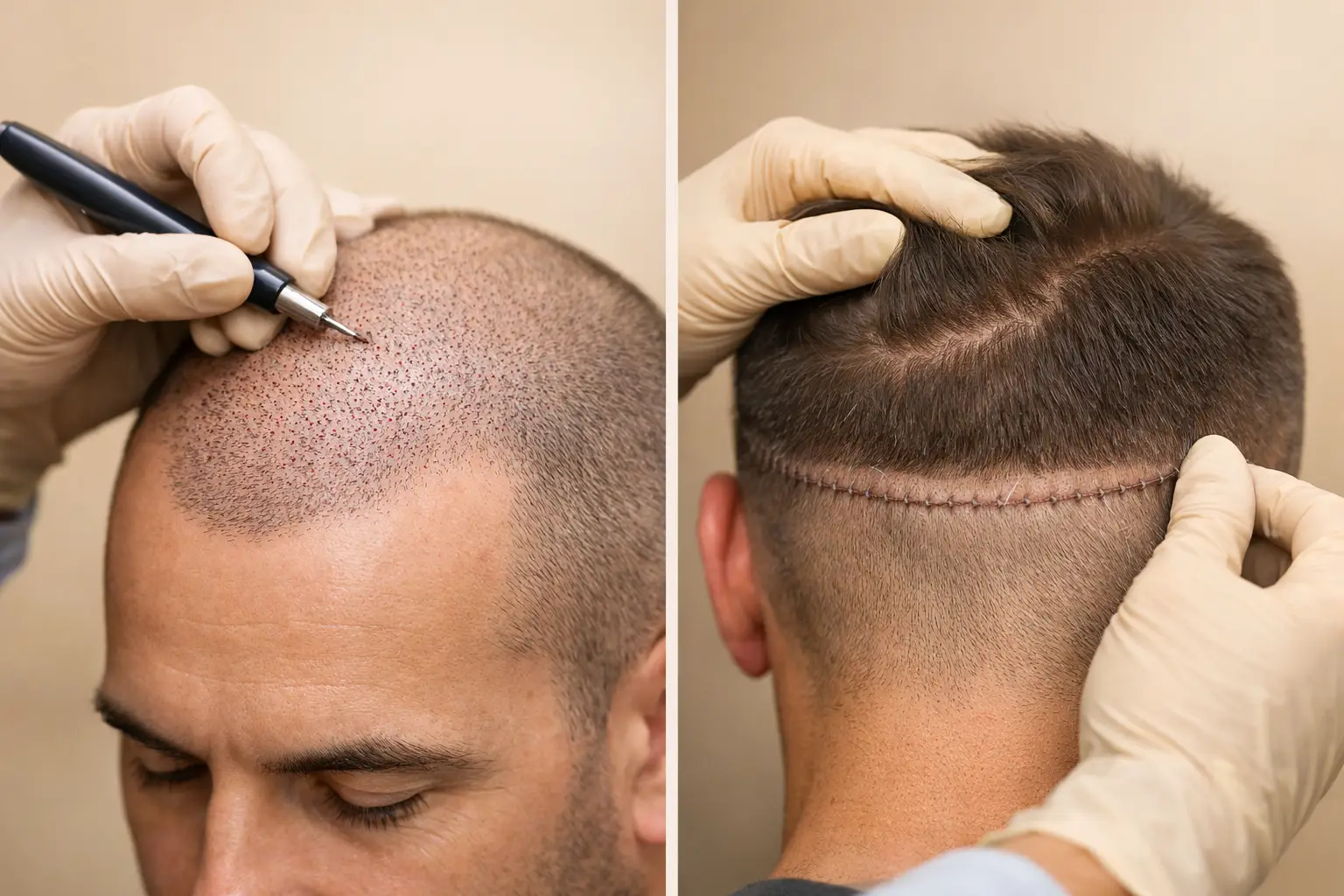
A hair transplant decision often comes down to one practical question: would you rather have a fine linear scar that can sit beneath longer hair, or many tiny extraction marks spread across the donor area? When comparing FUE versus FUT hair transplant procedures, that distinction matters, but it is not the whole story. Your pattern of hair loss, donor-hair quality, hairstyle, budget and long-term plan all deserve equal attention.
Both methods move healthy, genetically resistant hair follicles from the donor area, usually at the back and sides of the scalp, to areas affected by thinning or hair loss. Both can create natural-looking growth when planned and carried out appropriately by medical professionals. The better procedure is not automatically the newest, quickest or least visible option. It is the one that makes sensible use of your available donor hair while fitting your goals.
FUE versus FUT hair transplant: the key difference
FUE stands for Follicular Unit Extraction. During an FUE procedure, individual follicular units are removed one at a time from the donor area using a small punch. These units, which may contain one to several hairs, are then prepared and placed into tiny recipient sites along the hairline, crown or other thinning areas.
FUT stands for Follicular Unit Transplantation. It is also commonly called the strip method. A narrow strip of scalp is removed from the donor area, and the wound is closed with stitches. The strip is then carefully divided into individual follicular units for placement in the recipient area.
The implantation stage is broadly similar in both procedures. The major difference is how grafts are harvested. This affects the type of donor-area scar, the likely recovery experience and, in some cases, how efficiently a larger number of grafts can be obtained.
How FUE may suit your goals
FUE is often appealing to people who prefer to wear their hair short or want to avoid a single linear scar. Instead, it leaves small circular marks across the donor area. Once healed, these can be difficult to notice, particularly when extraction is carefully spaced and enough surrounding hair remains. They are still scars, however, and should be discussed openly rather than treated as invisible.
Because follicles are removed individually, FUE may be suitable for patients who need a smaller or moderate session, have scalp characteristics that make strip removal less favourable, or value the flexibility of shorter hairstyles. It can also be useful where a patient has an existing FUT scar and requires additional grafts around it.
The trade-off is that FUE requires careful management of the donor area. Taking too many grafts too close together can reduce density and create a moth-eaten appearance when the hair is clipped very short. A good treatment plan protects the donor supply for the future rather than focusing only on the number of grafts possible in one day.
FUE frequently involves trimming or shaving part, or sometimes most, of the donor area. For people who need to return quickly to work or prefer not to change their hairstyle noticeably, this is worth raising during consultation. Some candidates may be considered for non-shaven or partially shaved approaches, although these can add complexity and may not be appropriate for every case.
When FUT can be the better option
FUT can be a strong option for patients who require a larger number of grafts and usually wear their hair long enough to cover a fine linear scar. By removing a strip, the clinical team may be able to obtain a substantial graft yield while leaving the hair surrounding the scar largely intact.
For some patients with good scalp laxity, meaning the scalp has enough natural looseness for closure, FUT can preserve more of the surrounding donor density than widespread individual extraction. This can matter for people with advanced pattern hair loss who may require significant coverage now and may need to conserve donor resources for later treatment.
The principal consideration is the linear scar. Even with careful closure, every surgical incision heals differently. The scar is commonly concealed by longer hair, but it may be visible with a close fade, very short crop or shaved head. Tightness and discomfort at the donor site can also be more noticeable in the first part of recovery than with FUE.
FUT is not an outdated procedure simply because FUE is widely discussed. It remains a clinically relevant method for the right candidate. The most suitable choice depends on the scalp, the donor area and the long-term restoration strategy, not just what is currently popular online.
Scarring, recovery and returning to routine
Both FUE and FUT are surgical hair transplant procedures, so both involve healing time and aftercare. Temporary redness, swelling, scabbing and tenderness in the treated areas can occur. The implanted grafts need protection in the early days, and patients are generally advised to follow their clinician's guidance around washing, exercise, headwear, sun exposure and sleeping position.
With FUE, the donor area typically heals as a series of small extraction sites. With FUT, healing includes the strip incision and subsequent stitch removal or management, depending on the closure method used. Many people can resume non-strenuous work relatively soon, but the visible recovery period differs from person to person. If your job involves physical work, regular outdoor exposure or wearing a helmet, ask for advice tailored to your routine.
It is also normal for transplanted hairs to shed in the weeks after a procedure. This does not necessarily mean the transplant has failed. The follicles remain beneath the skin and new growth typically begins over the following months. Hair restoration requires patience: the final cosmetic result develops gradually, not overnight.
Graft numbers are not the only measure of value
It is easy to compare clinics by the number of grafts quoted, but graft count alone does not tell you whether a procedure is good value. The quality of the donor area, the calibre of the hair, the contrast between hair and scalp colour, the size of the thinning area and the design of the hairline all influence what can be achieved.
A conservative, age-appropriate hairline can use grafts wisely and look natural over time. An aggressively low hairline may appear appealing in the short term but can consume donor hair that may be needed if hair loss progresses. This is particularly relevant for younger adults and anyone whose pattern of hair loss is still changing.
The cost of an FUE or FUT hair transplant can vary according to the number of grafts, clinical complexity, level of medical oversight and the treatment plan. Affordable care should still include a proper assessment, clear explanation of risks and realistic expectations. Be cautious of quotes that promise a large graft number without examining donor density or discussing your future hair-loss pattern.
Your donor area guides the decision
The donor area is a limited resource. A thorough consultation should assess its density, hair characteristics, scalp condition and the amount of hair that can be harvested without creating an unnaturally depleted appearance. It should also consider whether you have had a previous transplant, scalp surgery or conditions that may affect healing.
Your current hair loss is only one part of the picture. A clinician should also ask about family history, medications, general health and whether hair loss is stable or progressing. In some cases, medical management or PRP treatments may be discussed as part of a broader plan to support existing hair, particularly where thinning is ongoing.
Not everyone is an immediate candidate for surgery. If the donor area is weak, hair loss is very diffuse or an underlying medical cause has not been assessed, the responsible next step may be further investigation or a non-surgical approach first. Honest advice can prevent disappointment and protect options for later.
Questions worth asking at consultation
Ask whether FUE or FUT is recommended for your specific donor area and why. You should also understand the estimated graft range, where those grafts will be placed, the likely scar pattern, the expected recovery process and what ongoing hair loss could mean for the result.
It is reasonable to ask who will carry out each stage of the procedure and how your care will be clinically supervised. You should leave with a clear picture of the likely benefits, limitations, risks and total cost, rather than pressure to make a quick decision.
For Australians considering treatment, a consultation with medical professionals can turn the FUE versus FUT question into a more useful discussion about protecting donor hair and planning for the years ahead. Luxe Medical Procedures offers clinically administered hair restoration consultations in Newcastle, Brisbane and Perth, helping patients consider an approach that is both medically appropriate and financially accessible.
The right transplant method should feel like a considered plan, not a sales pitch. Choose the option that respects your donor supply, suits how you wear your hair and gives you realistic confidence in the result.