
PRP Versus Hair Transplant Options Compared
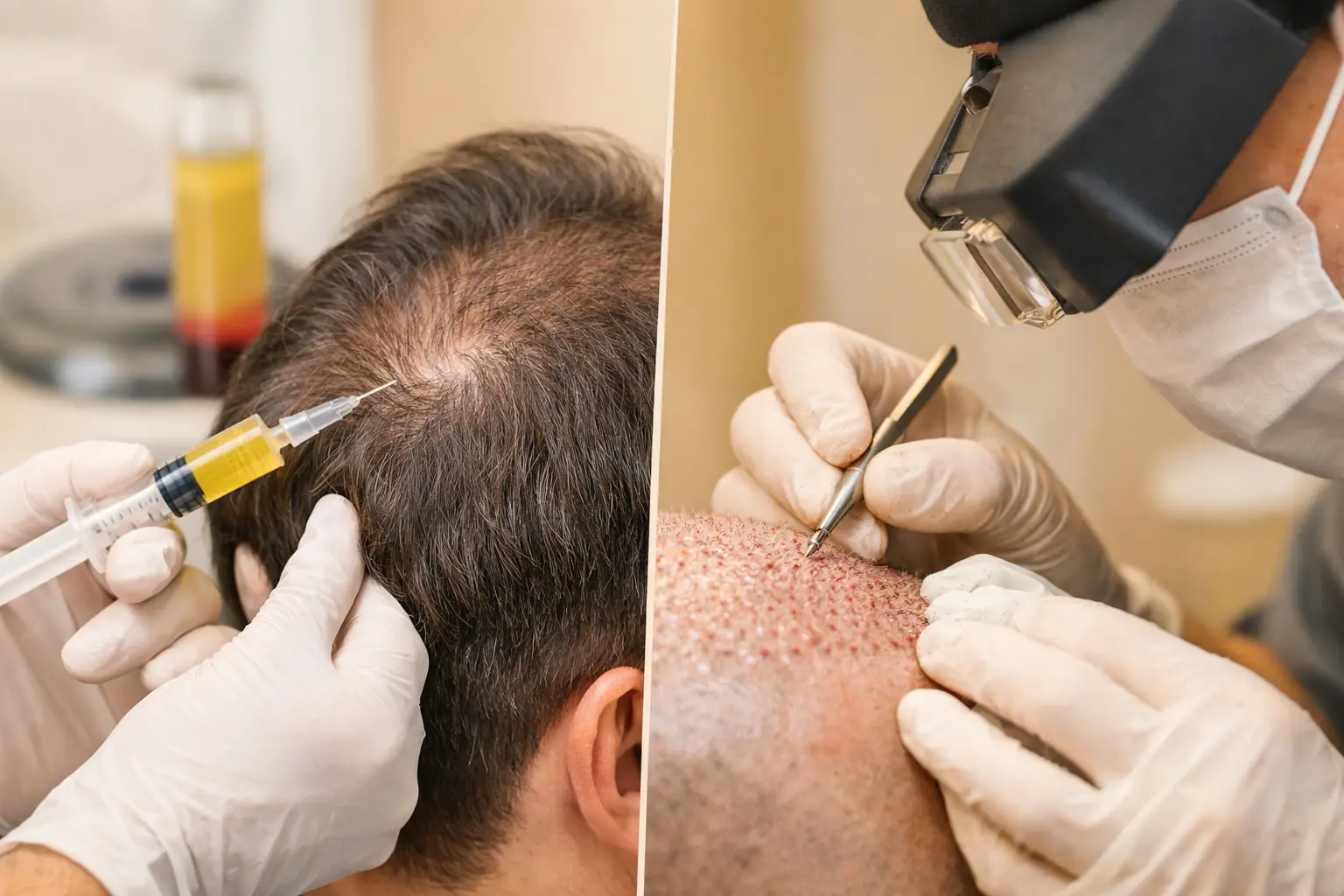
A thinning crown, widening part or receding hairline can make choosing a treatment feel more urgent than it needs to be. When comparing PRP versus hair transplant options, the most useful question is not which treatment is universally better. It is which approach suits the pattern, stage and cause of your hair loss - and whether your existing hair can still respond to non-surgical support.
PRP treatments and hair transplants are both clinically delivered hair-restoration options, but they work in very different ways. PRP aims to support existing, weakened follicles. A hair transplant redistributes healthy follicles from a donor area to areas with permanent thinning or baldness. The right pathway may involve one treatment, the other, or a carefully planned combination.
PRP versus hair transplant options: the key difference
Platelet-rich plasma, or PRP, is made from a small sample of your own blood. The blood is processed to concentrate platelets and plasma, then the PRP is injected into targeted areas of the scalp by a qualified practitioner. Platelets contain growth factors that may support follicle activity and scalp health.
PRP does not add new follicles to the scalp. Its role is to help preserve or improve the performance of follicles that are still present but producing finer, weaker hair. For people noticing early thinning, reduced density or ongoing shedding, this can make PRP a practical non-surgical option to discuss with a medical professional.
A hair transplant is a surgical procedure. Healthy hair follicles are taken from a donor area, usually at the back or sides of the scalp, and placed into thinning areas such as the hairline, temples or crown. Once transplanted follicles establish and grow, they can provide long-term coverage because they generally retain characteristics of donor-area hair.
This distinction matters. PRP may improve the appearance and quality of existing hair, while a transplant can restore hair to an area where follicles are no longer actively growing.
When PRP may be the better starting point
PRP can be suitable for people with mild to moderate thinning, particularly when there is still visible hair across the affected area. It may also appeal to those who are not ready for surgery, want minimal interruption to work and social commitments, or would prefer to begin with a lower-commitment treatment plan.
A course of PRP treatments is commonly recommended rather than a single appointment. Your practitioner will determine the appropriate schedule based on your hair loss pattern, medical history and treatment response. Maintenance treatments may be advised because pattern hair loss can continue over time.
Results vary. Some people see reduced shedding or thicker-looking existing hair over several months, while others may see more modest change. PRP cannot reliably recreate a lost hairline or fill a completely bald area. It is also not a replacement for investigating possible underlying causes of sudden or diffuse hair loss, such as illness, nutritional deficiencies, hormonal changes or medication effects.
Recovery after PRP is generally straightforward. Temporary scalp tenderness, swelling, redness or bruising can occur around injection sites. Because it uses your own blood components, PRP avoids introducing a donor substance, but it is still a medical procedure and should be carried out under appropriate clinical oversight.
When a hair transplant may offer more meaningful change
A hair transplant may be a stronger option when hair loss is established and there are areas where little to no hair remains. It can be especially effective for rebuilding a receding hairline, adding density through the frontal scalp or improving crown coverage where suitable donor hair is available.
The procedure is not simply about moving the maximum number of grafts possible. Good planning considers facial proportions, age, future hair-loss progression, donor supply and the density that can be achieved safely. A conservative, natural-looking hairline can be more valuable than an overly low design that may not suit you if loss progresses later.
Transplanted hair does not appear immediately. In the early weeks, the transplanted hairs often shed as part of the normal process. New growth typically begins gradually after several months, with the cosmetic result continuing to develop over 12 months or longer. This requires patience, but it also means a transplant is designed for a longer-term outcome rather than a quick cosmetic fix.
Recovery involves more care than PRP. You will need to follow instructions around washing, sleeping, exercise, sun exposure and avoiding disturbance to grafts during the early healing period. Scabbing, temporary redness and swelling can occur. A medically administered procedure gives you a clear care plan and access to professional guidance if concerns arise.
Donor hair and future loss shape the decision
The amount and quality of donor hair is one of the most important factors in transplant suitability. Donor follicles are limited, so they need to be used strategically. A consultation should assess not only the area you would like treated now, but also the likelihood of further hair loss and how this may affect future coverage.
For example, someone in the early stages of male or female pattern hair loss may benefit from first focusing on hair preservation. If existing hairs continue to miniaturise around newly transplanted hair, the contrast can become noticeable over time. PRP may have a role in supporting existing hair before or after a transplant, depending on the individual plan.
On the other hand, if a person has stable, established hair loss and a strong donor area, transplant surgery may provide a more visible improvement than PRP alone. Neither option should be selected solely from photos online or based on a single price comparison.
Cost is important, but value is more than the upfront figure
Hair restoration is often perceived as financially out of reach, particularly surgery. Cost understandably affects the decision between PRP and hair transplant options. PRP usually has a lower upfront cost per session, but treatment may involve an initial course and ongoing maintenance. A transplant is a larger initial investment because it involves surgical planning, medical staff, graft handling and post-procedure care.
The most useful comparison is the cost of a treatment plan that is appropriate for your goals, rather than the advertised cost of one session or a small number of grafts. Ask what is included, how the procedure is performed, who is responsible for your care and what follow-up support is available.
Affordability should never mean compromising on clinical standards. Hair-restoration procedures involve your scalp, blood or surgical grafts, so professional assessment and appropriate hygiene protocols matter. At Luxe Medical Procedures, hair transplants and PRP treatments are carried out by medical professionals, with plans shaped around suitability rather than a one-size-fits-all sales approach.
Questions to take to a hair-restoration consultation
A quality consultation should leave you clearer about what is realistic. You should understand whether your hair loss appears stable or progressive, whether you have enough donor hair for a transplant and what level of density is achievable.
It is also reasonable to ask whether PRP is likely to support your existing hair, how many treatments may be recommended, what recovery involves and what result timeline is realistic. If a transplant is suggested, ask how the hairline or treatment area will be designed with future hair loss in mind. Clear answers help you weigh both the medical and financial commitment with confidence.
Medical professionals may also recommend that you speak with your GP or seek further assessment if your hair loss is sudden, patchy, accompanied by scalp symptoms or linked to broader health changes. Hair loss has different causes, and the best treatment begins with identifying the likely one.
Choosing a pathway that fits your hair loss
PRP and hair transplants are not competing treatments in every case. PRP may be used to support thinning existing hair, while a transplant addresses areas where follicles have been permanently lost. For some people, PRP is a sensible first step. For others, waiting too long for a transplant may simply prolong dissatisfaction with a hairline or density that non-surgical treatment cannot restore.
The right choice comes from an honest assessment of your hair, your donor area, your budget and your expectations. A clinically guided consultation can turn a confusing decision into a practical plan - one that respects both the long-term health of your hair and the confidence you want to regain.